Product teams, analysts, QA, delivery leads

Turn long refinement loops into ready stories.

Feature refinement usually means repeated meetings, rewritten notes, missing context, and slow alignment between product, engineering, QA, and stakeholders. Storymate uses AI at every step to turn that shared effort into a faster, clearer workflow.

Free tier 30 story slices/month · 1 project · No credit card required
01
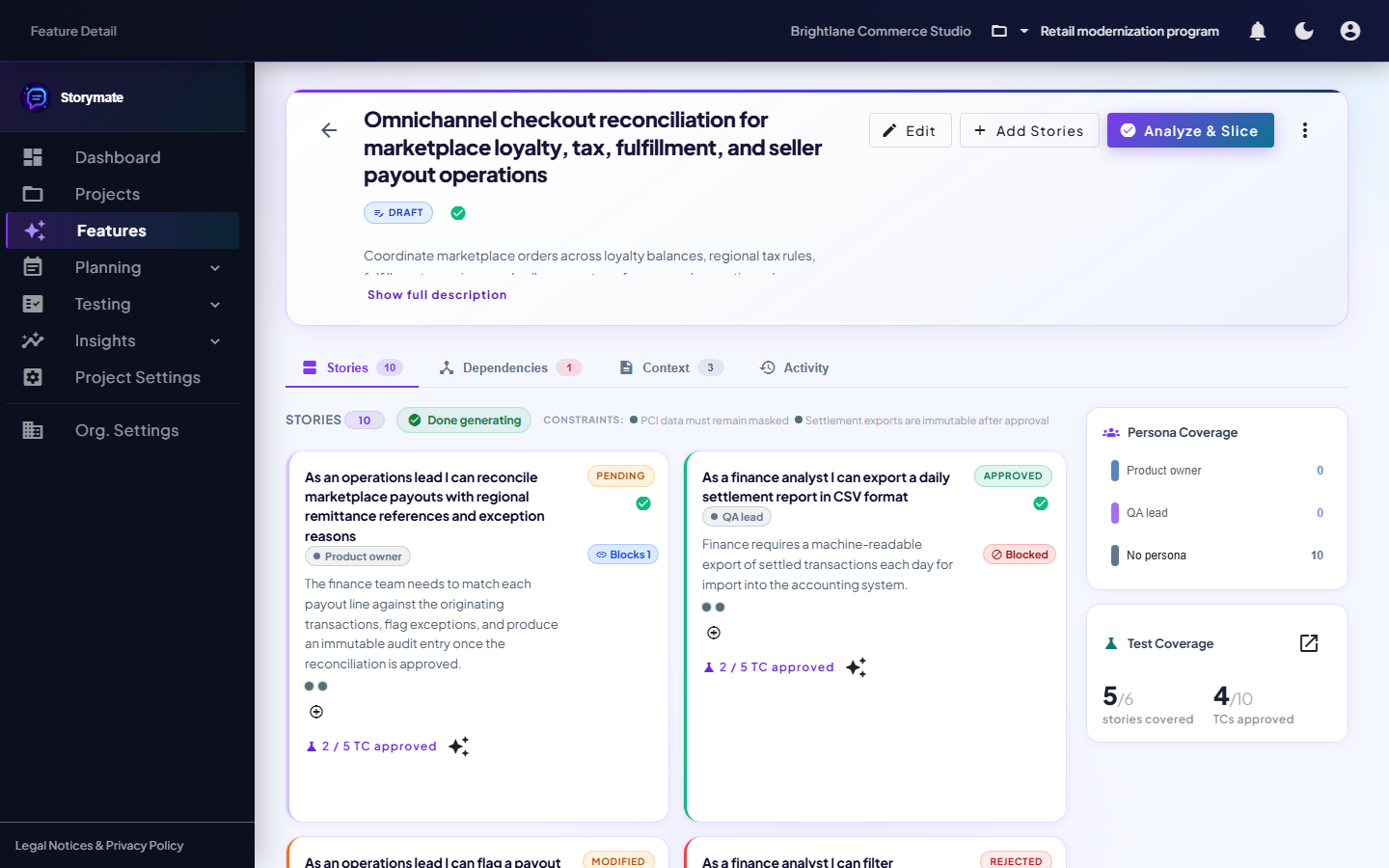
Bring the contextAI reads epics, documents, prompts, personas, and readiness rules before anyone starts rewriting.
02
Slice and refineAI proposes stories and improvements so review time is spent deciding, not drafting from scratch.
03
Deliver with evidenceAI carries decisions forward into tests, plans, exports, and traceability.
workspace / feature slicing
Storymate feature detail with generated stories
Free forever

Start slicing. No payment needed.

The free tier is not a limited trial. Sign up in seconds and get a real working account with 30 story slices resetting every month — no credit card, no expiry date.

Create a free account
Free plan $0 / month
  • 30 story slices per month
  • 1 project
  • AI story slicing
  • Custom domain prompts
  • Document context
  • Connectors (Jira, ADO, GitHub, GitLab)
  • Test case management
  • API access
  • SAML / SSO
Compare all plans →

Less refinement drag, more shared clarity.

Storymate keeps the thread from source material to final story, test case, sprint plan, and stakeholder view, so every participant works from the same evolving context.

Slicing

Features become reviewable stories

AI turns rough ideas into structured drafts using your domain prompts, documents, personas, and project standards.

Quality

Quality checks happen while refining

AI helps validate acceptance criteria, readiness, NFR coverage, and testability before the story reaches sprint planning.

Evidence

Decisions stay connected

AI-assisted traceability keeps features, stories, tests, plans, and stakeholder feedback linked without manual reconstruction.

Fits your landscape

Not another backlog island.

Storymate sits between discovery and delivery. It improves refinement with AI, then hands work back to the systems your teams already use for planning, engineering, documentation, and QA.

Teams do not need to abandon Jira, GitHub Issues, Azure DevOps, GitLab, Confluence, Xray, TestRail, or Zephyr Scale to get better stories. Storymate acts as the refinement layer: it reads context from existing sources, structures the output, keeps the review trail visible, and pushes the result back into the operational toolchain.

InputEpics, documents, prompts, personas, domain rules
RefineAI slicing, review, quality checks, test generation
OutputIssues, test cases, traceability, sprint plans, exports
Feature intake

Start refinement with the context already assembled.

Refinement gets slow when every role brings a different version of the problem. Storymate gives AI the source feature, connected backlog items, reference documents, personas, and project prompts before it proposes any stories.
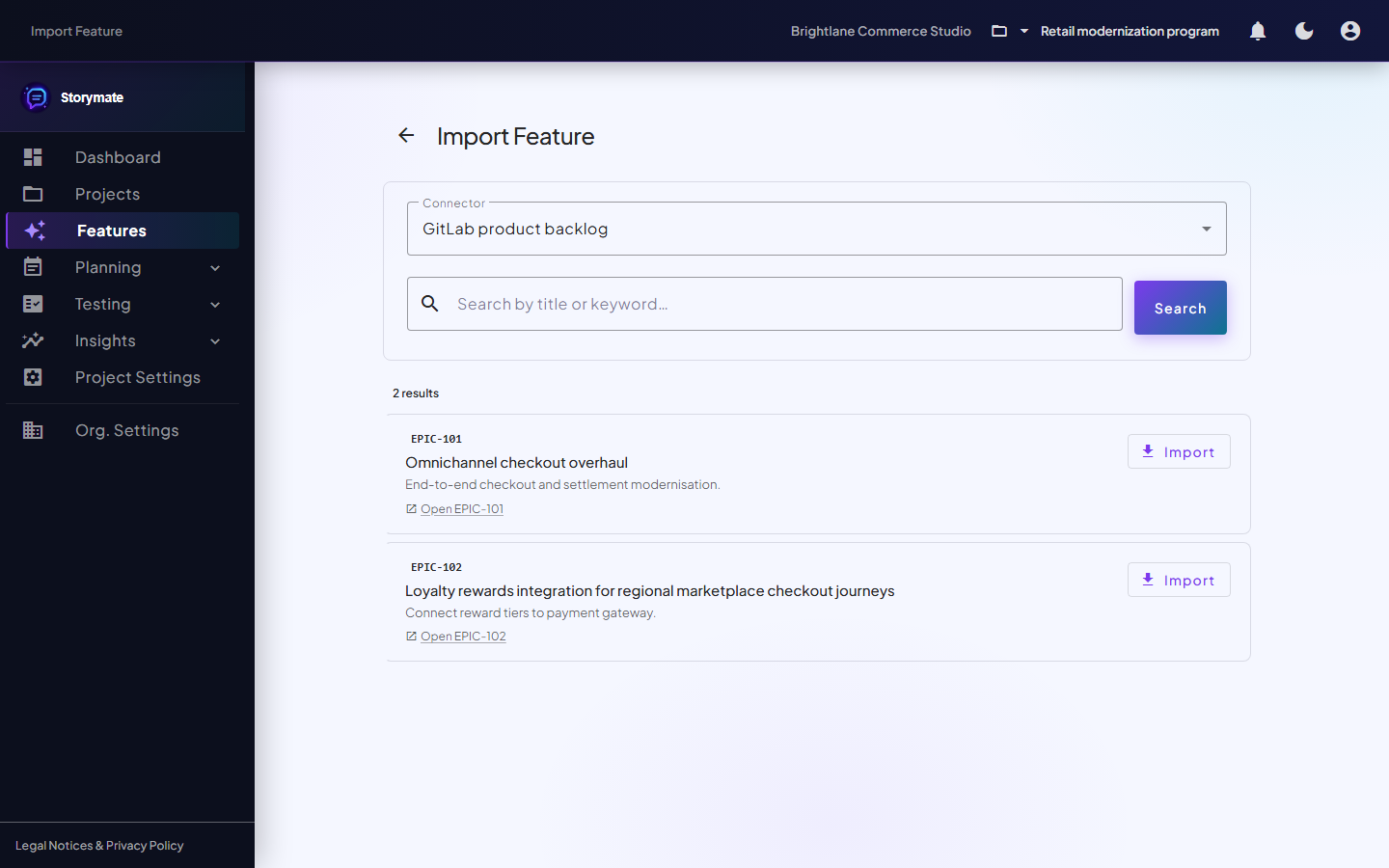
What changesShorter kickoff cycles and fewer clarification meetings. Product owners spend less time collecting context, while engineering and QA see the assumptions behind every generated story.
  • Search existing epics and backlog items before creating duplicate discovery work.
  • Keep imported source text attached to the feature so reviewers can compare generated stories against the original intent.
  • Use AI to combine imported context with prompts, personas, and documents for stronger first drafts.
  • Reduce the first refinement meeting from "what are we even building?" to "which generated slice is right?"
workspace / imports
Storymate feature import screen
Traceability

Keep every refinement decision explainable.

When many people refine the same feature, decisions scatter across tickets, chats, meetings, and test plans. Storymate keeps the chain visible so teams can see why a story exists and what still needs coverage.
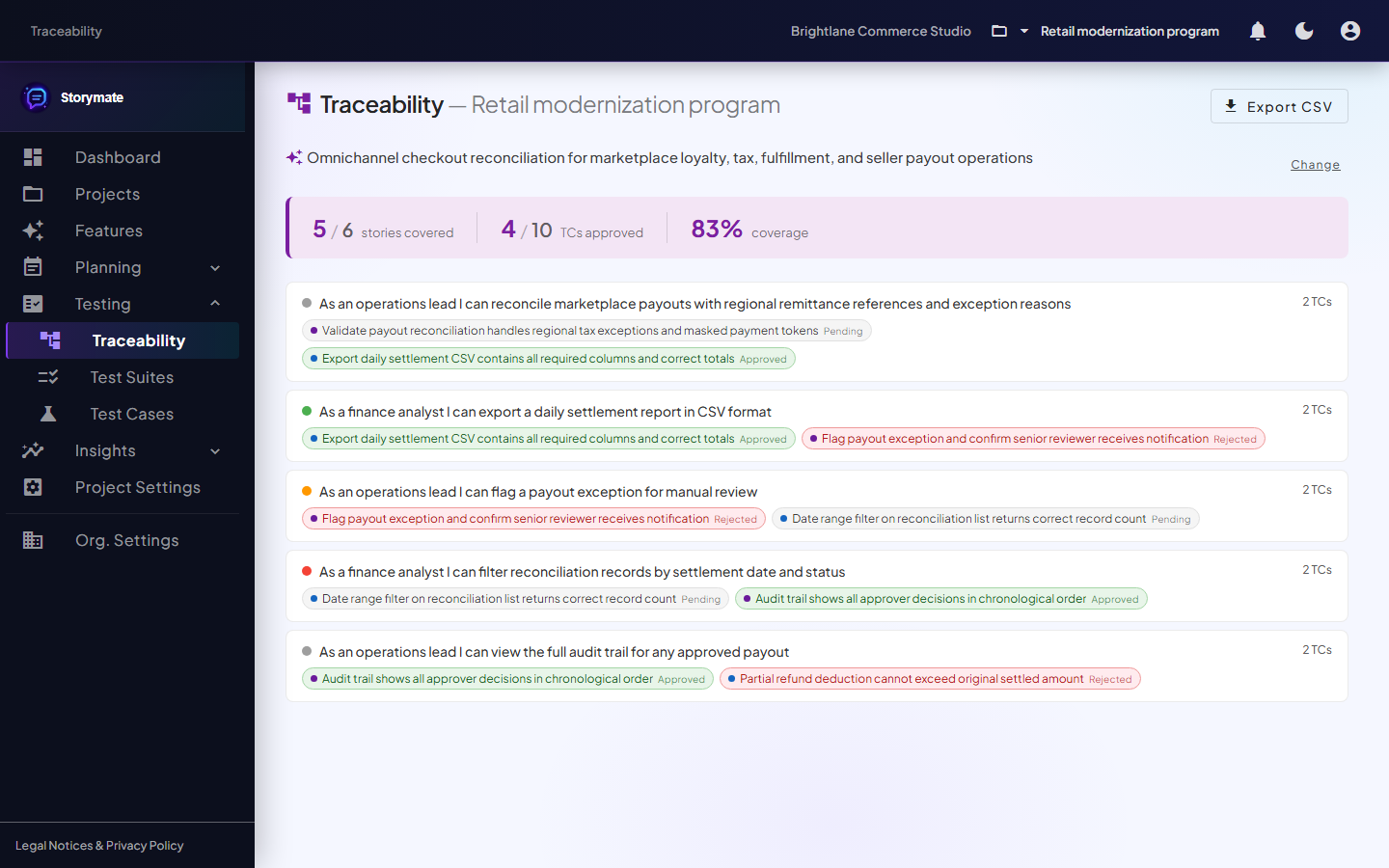
What changesLower audit and release risk. Teams can prove what has been covered, which stories still need work, and where missing tests or requirements would otherwise surface late.
  • Follow the chain from feature through generated stories and linked test cases.
  • Let AI highlight missing coverage before it becomes a release, audit, or stakeholder conversation.
  • Export a clear evidence view when teams need to explain what was sliced, reviewed, and tested.
workspace / traceability
Storymate traceability matrix
Planning

Move from refined stories to delivery without another handoff.

Planning often repeats refinement: teams reread stories, regroup work, rediscover dependencies, and rebuild context. Storymate carries approved stories forward and uses AI to suggest sprint candidates from the work already reviewed.
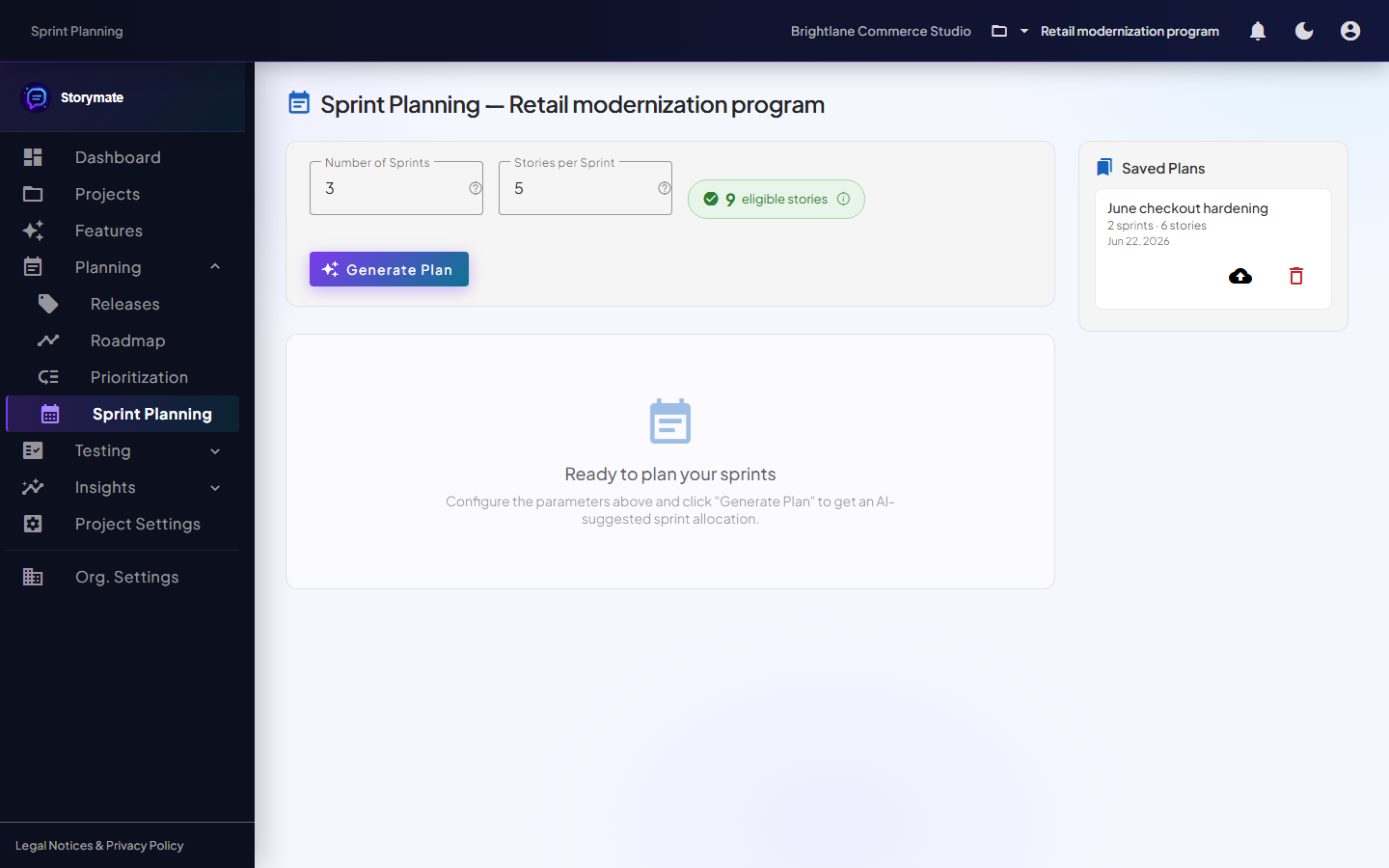
What changesLess planning overhead and fewer stale backlog items. Approved work can move into sprint conversations with context, priority, and rationale already attached.
  • Start from approved stories instead of manually rebuilding a sprint candidate list.
  • Use AI suggestions as a starting point, then adjust allocation while keeping decisions connected to the source feature.
  • Export sprint plans through connectors when the team is ready to move from shaping to delivery.
workspace / sprint planning
Storymate sprint planning screen
Test management

Bring QA into refinement earlier.

QA refinement often starts after the story is "done," when context has already cooled off. Storymate uses AI to generate test cases from approved stories while acceptance criteria, constraints, and open questions are still visible.
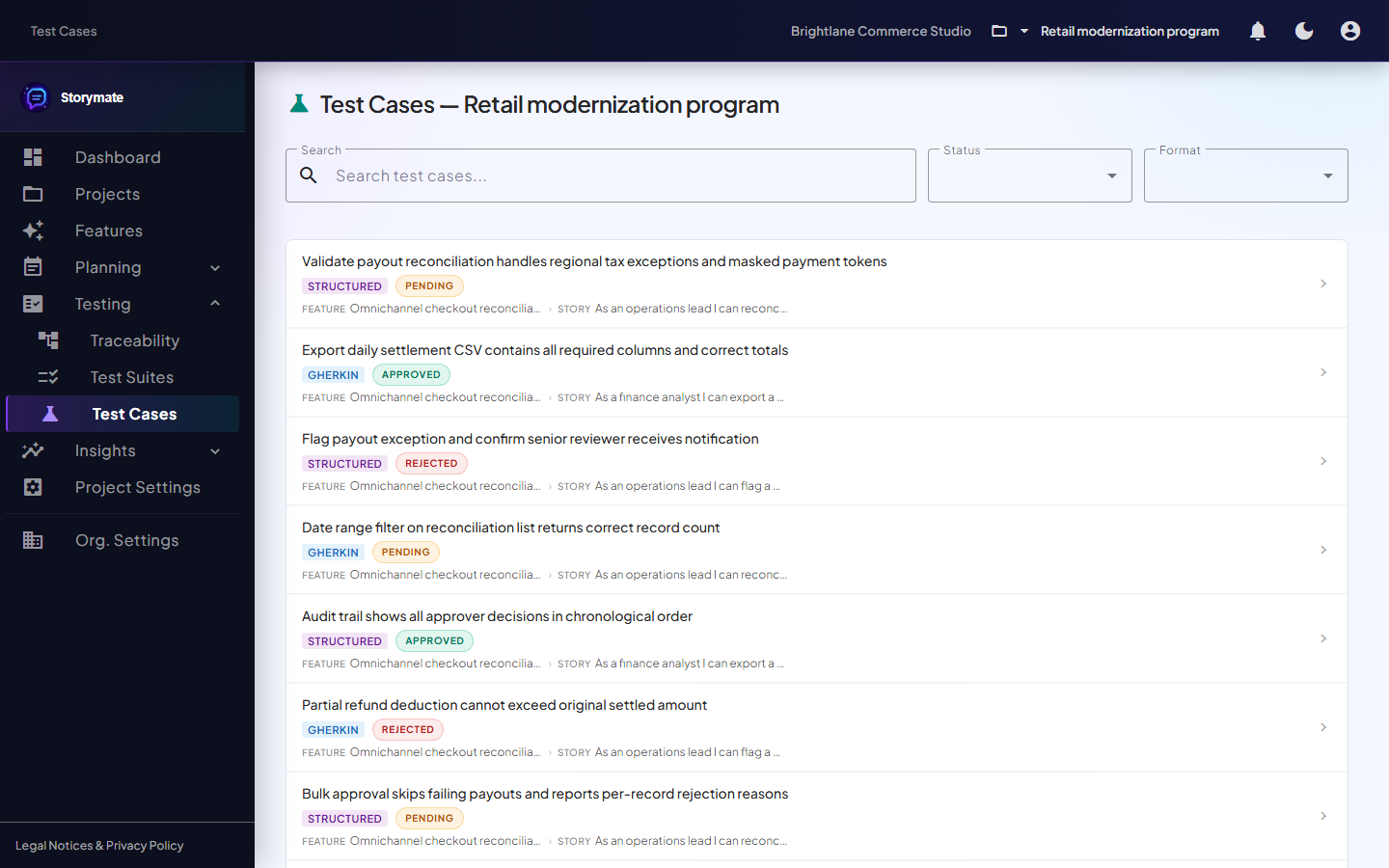
What changesHigher test coverage with less rework. QA can review generated tests while the product decision is fresh, and defects caused by ambiguous acceptance criteria can be caught earlier.
  • Create AI-generated Gherkin or structured test cases from reviewed stories, not from memory after refinement is over.
  • Review generated tests alongside the story so acceptance criteria and test intent stay aligned.
  • Push test cases into TestRail, Xray, or Zephyr Scale without losing the link back to the product decision.
workspace / test cases
Storymate test cases screen

Connect Storymate to the tools around it.

Push stories and test cases out, pull reference material in, and keep the source of truth where your teams already work.

Toolchain

Push refined work where teams already execute.

The value of AI refinement is lost if someone has to manually copy the final story into another system. Storymate keeps generated work structured and sends it into the tools your delivery, documentation, and QA teams already use.
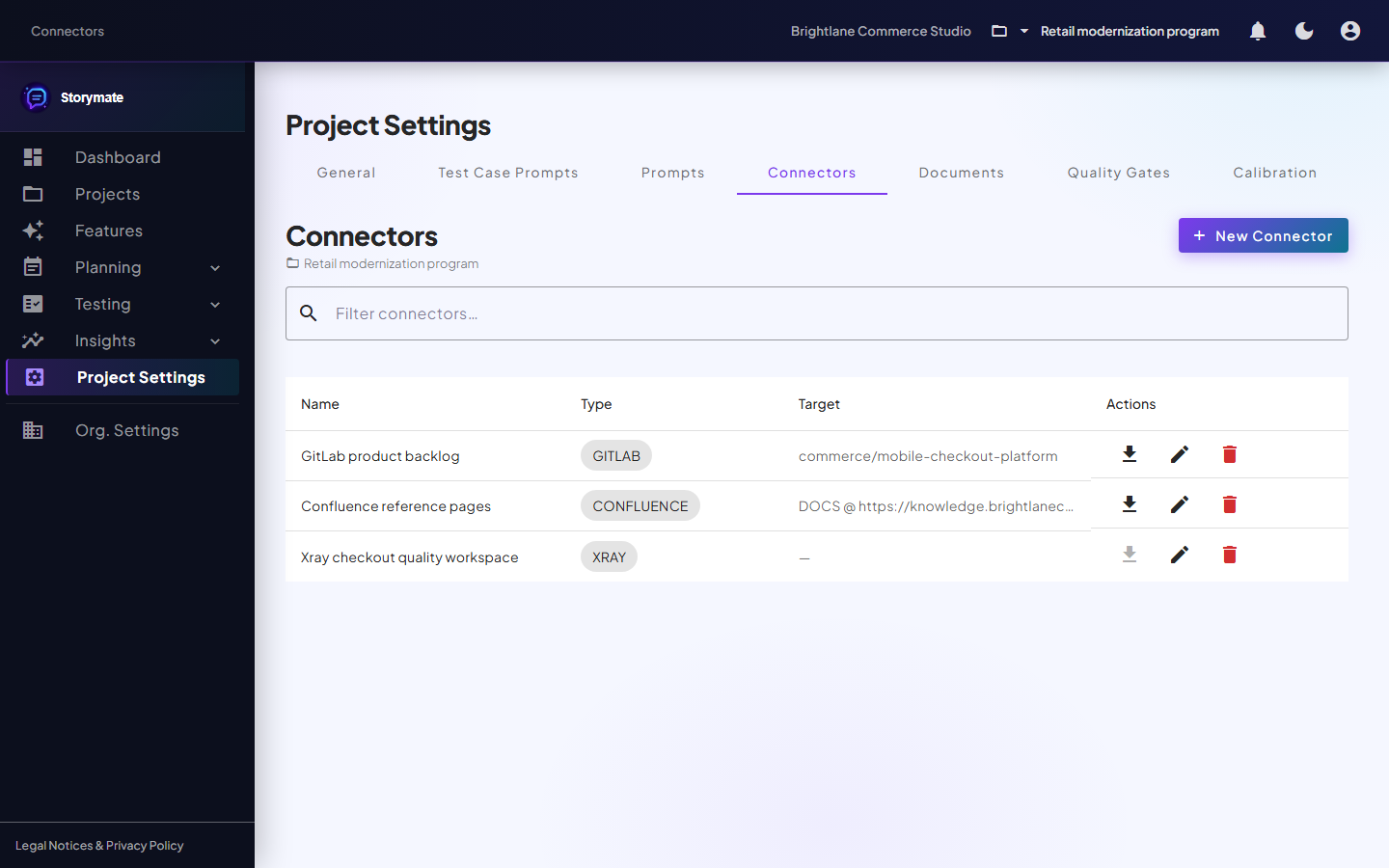
What changesLess double entry and cleaner operational data. Teams can adopt AI-assisted refinement without replacing Jira, Azure DevOps, GitHub, GitLab, Confluence, or QA tooling.
  • Pull reference material from documentation systems so AI slicing uses the latest domain context.
  • Push AI-refined stories into issue trackers with the structure your downstream teams expect.
  • Keep connector configuration at project level, so each team can match its own delivery stack.
Jira
ADO
GitHub
GitLab
Confluence
TestRail
Xray
Zephyr
workspace / connectors
Storymate connectors screen

Use AI without adding another AI vendor.

Storymate can run against your own LLM infrastructure, so teams can benefit from existing security, procurement, data residency, and billing agreements.

LLM control

Bring the model stack your company already trusts.

AI only creates business value when legal, security, and finance can approve how it is used. Storymate supports configurable LLM profiles, so organizations can route refinement, slicing, test generation, and analytics through their preferred provider or private deployment.
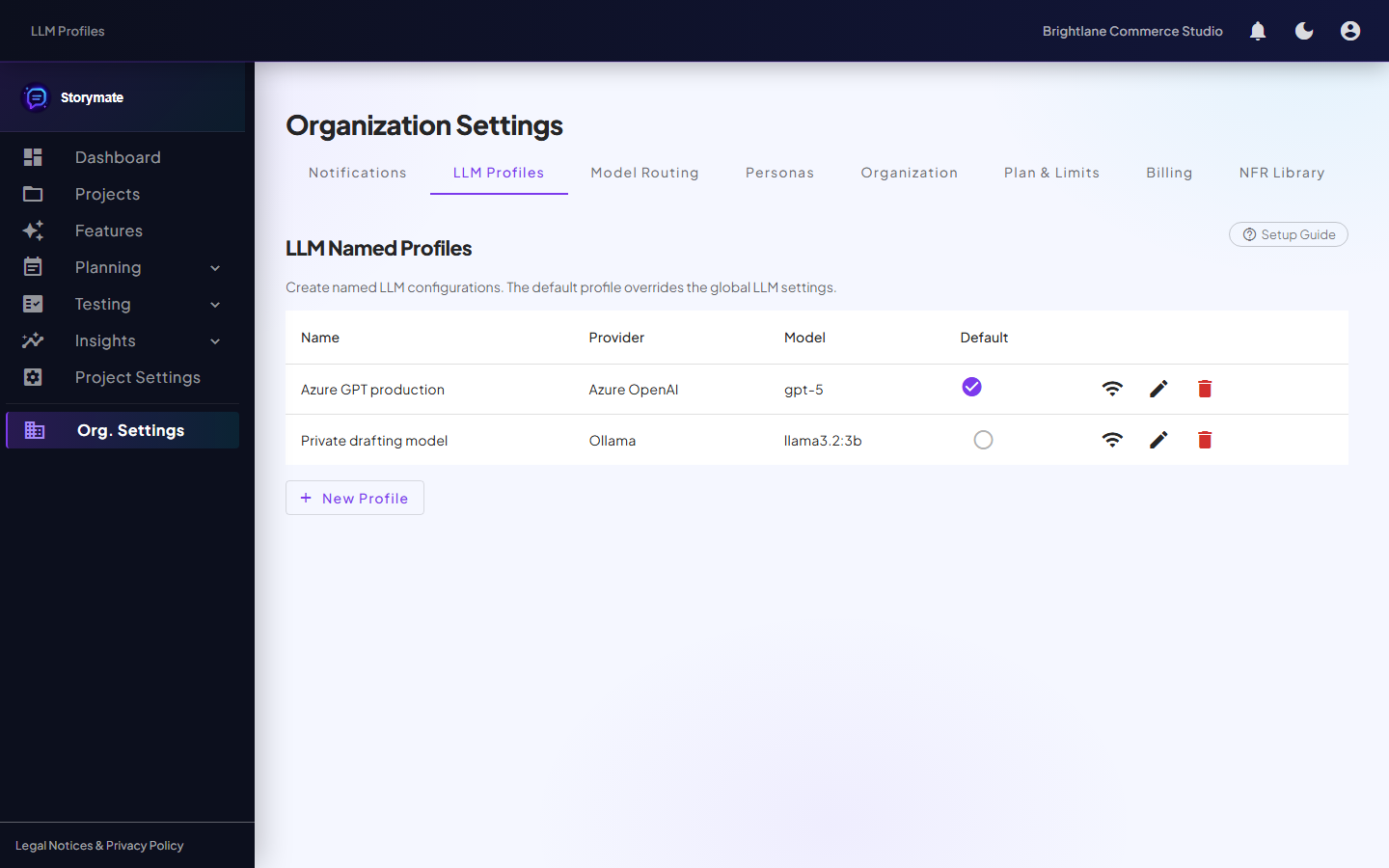
What changesAdopt AI-assisted refinement without creating a new data-risk exception or a surprise LLM bill. Use the contracts, guardrails, regional controls, and spend commitments your organization already has.
  • Configure provider-specific profiles for different teams, environments, or model capabilities.
  • Keep sensitive backlog, customer, and product data within the LLM infrastructure your organization has approved.
  • Use better models over time without changing the refinement workflow teams rely on.
workspace / llm profiles
Storymate LLM profiles configuration screen
Analytics

Measure the refinement process itself.

Refinement is expensive because it consumes the attention of product managers, engineers, QA, architects, stakeholders, and delivery leads at the same time. Analytics turns that preparation layer into something measurable: how much AI-generated work survives review, where rejection patterns appear, whether story size is drifting, and how delivery conversations improve over time.
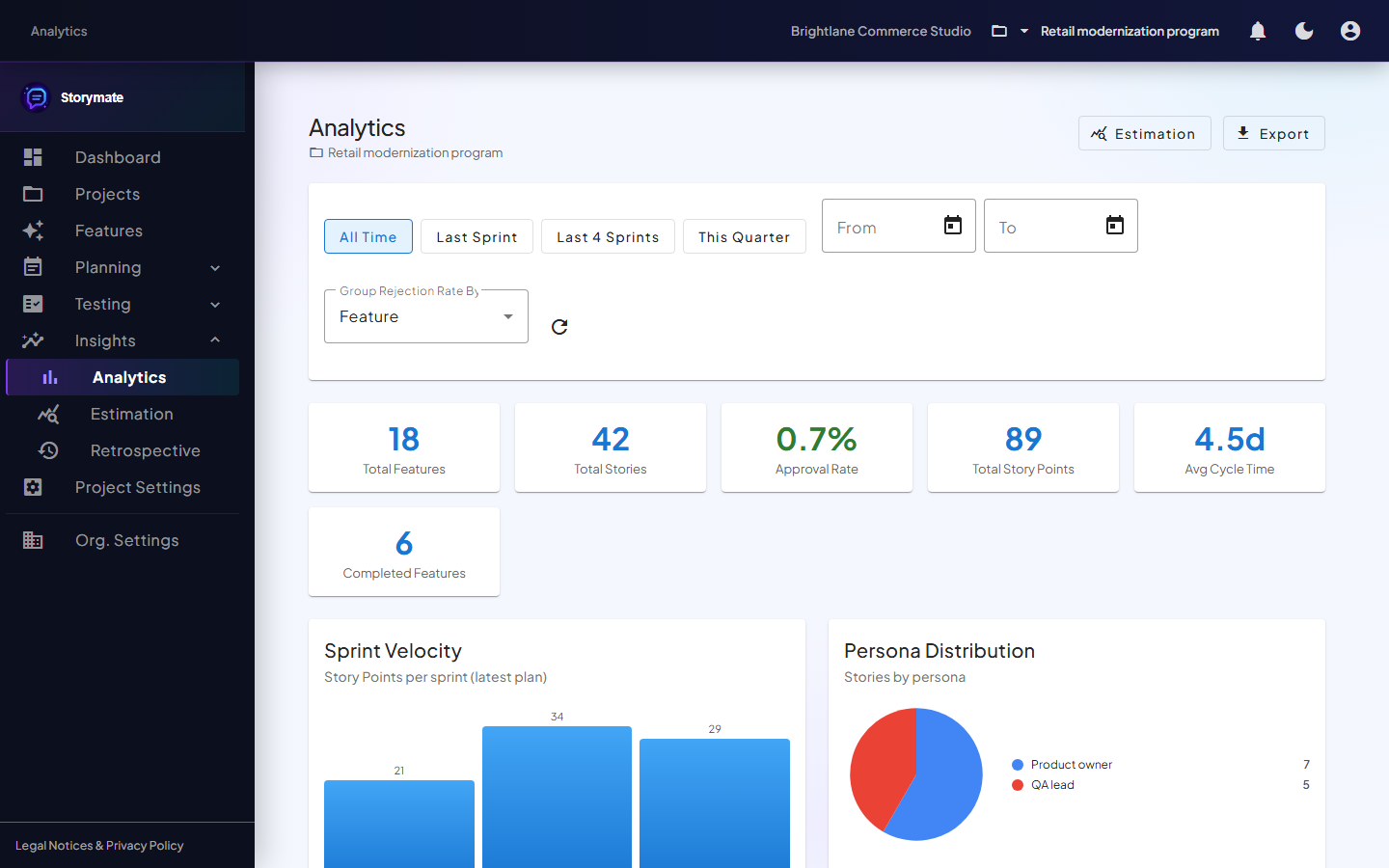
What changesMake story quality and refinement efficiency visible. Leaders can see whether AI is reducing churn, where review bottlenecks remain, and which parts of the portfolio need better inputs.
  • Watch review throughput, rejection rate, cycle time, and bottlenecks across projects.
  • Compare persona and feature-area distribution to see whether the backlog is balanced.
  • Use AI-assisted retrospectives and exports to bring story quality trends into team improvement rituals.
workspace / analytics
Storymate analytics dashboard

Start free. No credit card required.

Sign up in seconds, add your project context, and turn the next feature into stories your team can actually review. The free tier gives you 30 slices per month to try it on real work.